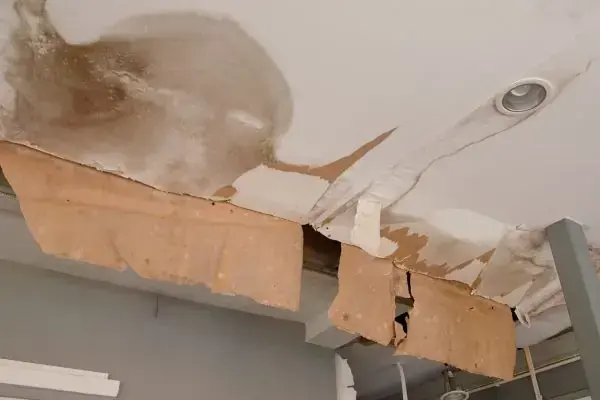
A brown ring on the ceiling of a Brookline apartment often means the problem is not in that apartment at all. With brick apartment blocks along Beacon Street, two- and three-family homes and condo conversions, the water frequently comes from the unit above.
Key takeaways
- A ceiling stain in a stacked building often traces to a bath, kitchen or laundry in the unit above.
- A bulging or sagging plaster ceiling is a safety problem, because wet plaster is heavy and can drop.
- The circuit for lights and outlets in the wet area is switched off at the panel before anyone uses a switch.
- The owner, manager or association of the unit above is told at once, and the stain is photographed with dated notes.
- A ceiling cavity is opened and dried, not just painted, or the dampness stays above the stain.
Why a ceiling stain in Brookline often starts upstairs
Brookline's housing is built in layers. Brick apartment blocks along Beacon Street, two- and three-family homes and condo conversions share floors, ceilings and pipes.
About half of the homes date to before 1940, so plaster ceilings on wood lath are common.
A plaster ceiling soaks water into the plaster itself and the wood lath behind it, while a drywall ceiling bulges and tears sooner.
The wet spot on a ceiling is where the water came down, which is not always where it started. Common sources overhead include:
- A tub or shower pan that seeps through the floor
- A toilet seal or the supply connection beneath it
- A kitchen sink, dishwasher or ice maker supply
- A washing machine hose on an upper floor
- A radiator or heating pipe in the floor above
Reading the stain
A stain that is still active
A stain that grows, feels damp or drips is active, and the source is still adding water.
Bubbling or peeling paint is another sign that moisture is present.
A stain that may be old
A stain with a hard brown edge that no longer changes may be old, but only a moisture reading can prove it.
A stain that returns after painting means the source is still leaking.
Water that travels
Water can run along joists and pipe openings and show up far from the true source.
A bathroom leak can appear as a stain in a hallway ceiling below, which is why the walkthrough starts at the stain and works outward.
Safety first: sagging plaster and the lighting circuit
Wet plaster on lath is heavy, and water can loosen the plaster keys that hold a ceiling up. A ceiling that looks sound can fail with little warning.
Water near a ceiling fixture or a fan is an electrical hazard, because a fixture can fill with water and a switch used with wet wiring can shock.
The first steps in ceiling leak water damage work are short:
- Keep people and furniture out from under a bulging or sagging ceiling.
- Switch off the breaker for the lights and outlets in the wet area before anyone touches a switch.
- Leave the plaster alone, because the crew relieves trapped water in a controlled way so the ceiling does not drop.
- Ask the unit above to close the fixture valve or the main if the source is there.
- Move belongings out of the room, or cover what has to stay with plastic.
Who to tell and what to write down
In a rental, the owner or manager is told first. In a condo, the association or management company hears about it, and so does the owner of the unit above.
Photographs of the stain, any water on the floor and any damaged belongings come next, with dated notes on when the leak was first noticed.
If the unit above is empty or no one answers, the owner or manager is the one who can reach the shutoff.
A clear record makes every later conversation easier, whoever ends up responsible for the repair. It usually holds four things:
- The date the stain was first seen, and any change since
- Photos of the ceiling, the floor and any wet belongings
- The names of the people told, and when
- Any sound of running water or any odor in the unit above
How the ceiling is opened and dried
The tech who does the walkthrough traces the source with meters and a thermal camera, and the leaking fixture or pipe is shut off. The camera shows wet areas as temperature differences, and the meter turns that into a reading the team can track.
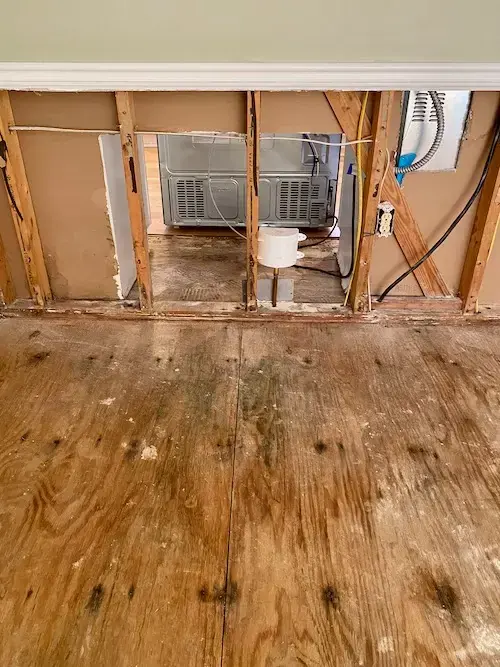
The extraction crew removes standing water from the floor below, and the ceiling is opened only where the readings show it is wet. In an old building that means small openings, so the rest of the plaster stays in place.
Air movers and dehumidifiers then dry the cavity between the floors, and readings are taken at each visit until the wood and plaster reach their dry goal. The method is laid out under structural drying.
Insulation, where there is any, is removed when it is soaked, and water standing on the floor below is handled first as water extraction.
When more than one unit is wet
A leak that crosses a floor can reach every unit below it. Drying is planned floor by floor, and each unit gets its own readings and photographs.
In a larger building the work is phased so occupied units stay usable. The approach for apartment buildings and condo associations is described under commercial and multifamily water damage.
Where the source is in a neighbor's unit, access matters. The source has to be reached to be stopped, and that is a conversation for the owner or manager.
Every unit that was reached gets the same records:
- Its own moisture readings at every visit
- Its own photographs of the damage and the drying
- Its own list of the materials that were removed
Stopping the next leak
A drip that is fixed early leaves the ceiling in place.
Most upstairs leaks start with a part that wears out slowly, so a few checks help:
- Check washing machine hoses for bulges or cracks
- Look under sinks for drips or swollen cabinet bases
- Re-caulk tub and shower edges where grout or sealant has opened
- Watch ceilings for new stains after heavy use of the unit above
Questions
Is a ceiling stain always from the unit above?
No. A stain can also come from a roof leak, a heating pipe or a bath directly overhead, which is why the source is traced with readings before anything is repaired.
Can a stained plaster ceiling just be painted over?
Paint hides the stain but not the moisture. Readings show whether the cavity above is still wet, and a wet cavity left closed keeps holding water.
Why is the lighting circuit switched off?
Water can fill a ceiling fixture or a junction box, and a switch used with wet wiring is a shock risk. The breaker for the wet area is turned off first.
Who should be told first when the source is another unit?
The owner or manager of the building, or the condo association and the owner of the unit above. A dated photo record helps all of them.
How is a plaster ceiling dried?
Small openings are cut where readings show water, then air movers and dehumidifiers dry the cavity until the wood and plaster reach their dry goal.
Can plaster that got wet be saved?
Often, if it is still firmly attached to the lath and the water was clean. Plaster that has sagged, crumbled or come loose is replaced.