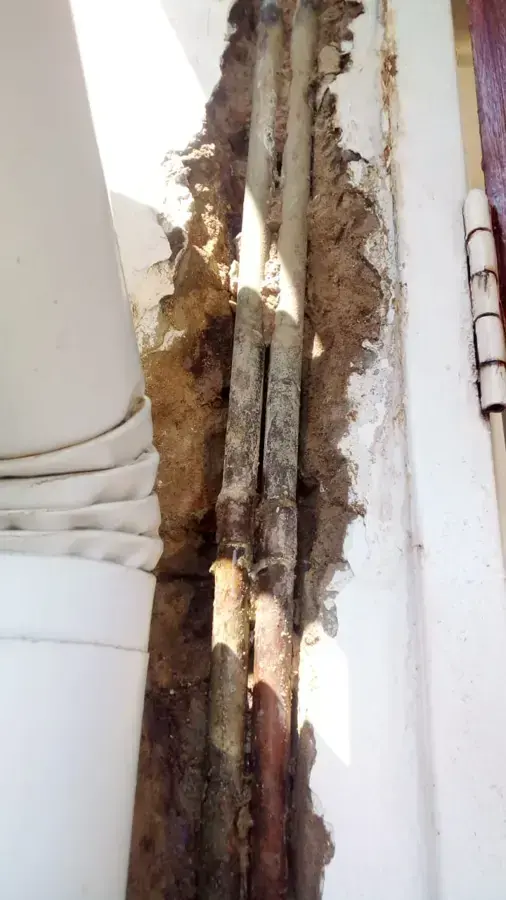
In prewar Brookline houses, galvanized supply pipe and cast iron drain stacks often run inside plaster walls. When one of those pipes fails there, the leak can run for a long time before a stain gives it away.
Key takeaways
- Galvanized supply pipe corrodes from the inside, so it can develop pinholes or split with little warning.
- Plaster over wood lath absorbs water, so a wall can be wet inside while the surface still looks fine.
- The water is shut off at the main first, and a tap on the lowest floor is opened to relieve pressure.
- Moisture readings and thermal imaging trace the wet area before any plaster is cut.
- Small access openings let air reach the wall cavity, and drying continues until the readings match a dry reference.
How galvanized pipe fails
Galvanized pipe is steel with a zinc coating. Over decades the coating wears away and rust forms on the inside, which narrows the pipe and thins its wall.
Threaded joints and fittings are common weak points, and a pinhole can open at a spot that looked fine from the outside.
Many old houses have been partly re-piped over the years, so galvanized steel can sit next to newer pipe. The place where two metals meet is a common spot for corrosion.
About half of Brookline's homes were built before 1940, and the Victorian and Colonial Revival houses on Fisher Hill, Aspinwall Hill and Corey Hill are part of that older stock. These are the usual warning signs:
- Rusty or brown water when a tap first opens
- Water pressure that has dropped over time
- A stain on a wall or ceiling that dries and returns
- Damp baseboards or a musty smell near a wall that holds pipes
Why a leak inside a plaster wall hides
Plaster over wood lath absorbs water and holds it. A wall can be saturated inside while the painted surface looks sound.
Water inside a wall also runs downward along the pipe and the framing, and it can show up as a stain on a ceiling or in a room below the leak.
By the time a stain appears, the cavity has often been wet for a while, which is why the first readings tend to find more water than the stain suggested.
A stain on the ceiling below is handled as ceiling leak water damage once the source is found.
Pinhole leak or split pipe
A pinhole leak
A pinhole leak is slow and steady. It can wet a wall for a long time without a sound or a puddle, and the first sign is often a stain or a musty smell.
A water meter dial that keeps turning with every fixture closed points to a leak somewhere in the building.
A split or burst pipe
A split releases water fast, and a plaster ceiling below can sag or drop.
The water is shut off at the main at once, and a tap on the lowest floor is opened to drain the system. Work on burst and leaking pipe cleanup starts from that shutoff, and the first steps are short:
- Close the main shutoff, usually near the meter
- Open a tap on the lowest floor to drain the system
- Switch off the breaker for wet rooms if the panel is dry
- Photograph the wall and the floor before anything is moved
Supply water and drain stack water are not the same
A leak from a supply pipe starts as clean water. A leak from a cast iron drain stack carries waste water, so it is handled as contaminated.
The difference changes the cleanup, so the first job is to find out which pipe is leaking.
- Supply pipe leak: clean water at first, so wet plaster and framing are usually dried where they stand
- Drain stack leak: waste water, so soaked porous materials come out and the cavity is cleaned and treated
How the wet area is traced and opened
The tech who does the walkthrough reads the wall with a meter and a thermal camera, starting at the stain and working outward.
Readings show where the water traveled, and openings are cut to that wet area rather than across the whole wall.
The pipe is exposed, the failed section is marked for the plumber and the opening is left so air can reach the cavity. Openings are sized so the plumber can reach the pipe and air can reach both sides of the wall.
Standing water on a floor below is pulled out first as water extraction.
Drying plaster and lath
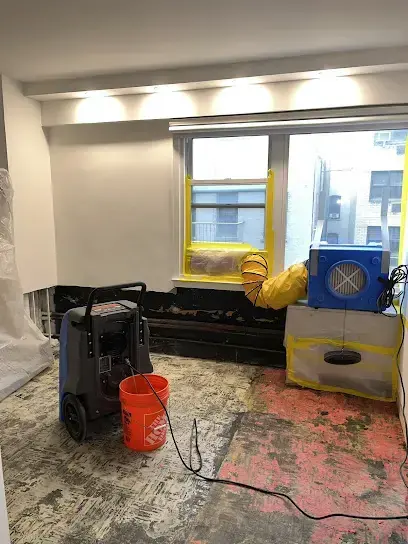
Air movers and dehumidifiers are set to match the readings. Plaster and lath release water slowly, so readings are taken at each visit until the wall reaches a dry reference.
Plaster that stays soft, crumbles or pulls away from the lath is replaced. Plaster that is only damp is dried and kept.
Hardwood floors and baseboards beside the wall are checked too, because water that ran down the cavity often reaches them.
The method follows the IICRC S500 standard and is described under structural drying.
Wet framing and plaster left closed can begin to grow mold in 24 to 48 hours, so drying starts early.
After the water is out: the repair
A plumber repairs or replaces the failed section of pipe, and the wall is closed once the readings are dry.
Insulation, where a wall has any, is removed if it was soaked.
Where one section of old galvanized pipe has failed, other sections of the same age may be in similar shape, so the plumber often checks the rest of the run.
A written list of the readings and photographs from each visit shows that the wall was dried before it was closed. These are the points to confirm first:
- The final readings match a dry reference
- The new pipe or fitting has been tested by the plumber
- Any soft or loose plaster has been replaced
- The photographs show the opening, the pipe and the dried cavity
Questions
How can a homeowner tell a wall has a hidden pipe leak?
Common signs are a stain that returns, damp baseboards, a musty smell, falling water pressure and rusty water. A moisture meter confirms it without opening the wall.
Does galvanized pipe have to be replaced after one leak?
The plumber decides. The failed section is repaired or replaced, and the rest of the run is checked, since pipe of the same age tends to wear in the same way.
Is water from a drain stack different from supply water?
Yes. A drain stack carries waste water, so a leak from one is handled as contaminated and soaked porous materials are removed.
Can plaster be dried after a leak, or does it have to come out?
Plaster that is only damp can usually be dried and kept. Plaster that has gone soft, crumbled or loosened from the lath is replaced.
What should be done first when a wall is wet?
Shut off the water at the main, open a tap on the lowest floor to relieve pressure, keep people clear of any sagging plaster and photograph the wall before anything is moved.
Why does the stain sometimes appear far from the leak?
Water runs down inside the wall along the pipe and the framing, so a stain can show on a ceiling or in a room below the leak.