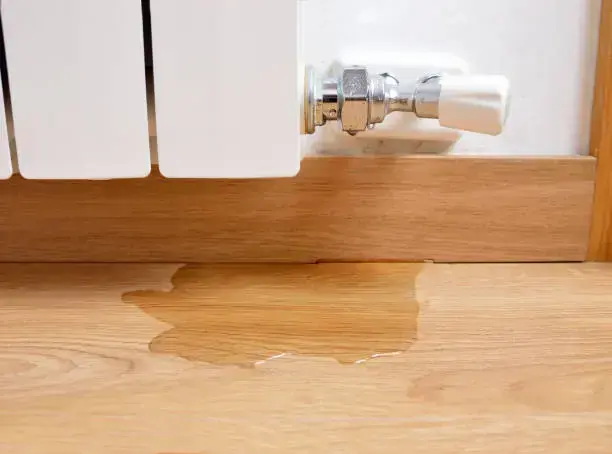
The first cold week of fall is when old heating systems are tested after a summer of sitting idle. In Brookline, where about half of the homes were built before 1940, steam and hot-water radiators, boilers and baseboard loops are a familiar source of water on the floor. A small drip at a valve can end up as a stain on the ceiling of the unit below.
Key takeaways
- Radiator valves, air vents, unions and boiler fittings are the usual leak points when heat first runs after the summer.
- A boiler with an automatic fill valve can keep replacing lost water, so a slow leak can go unnoticed for a long time.
- Hot water and steam can scald, so the boiler is switched off and the radiator valve closed only where that is safe, and everyone keeps clear of the source.
- Radiator water rarely stays on the surface. It soaks hardwood, drops into the subfloor and stains the plaster ceiling below.
- A heating technician fixes the leak at its source, while the drying team removes the water and dries the floor, subfloor and ceiling to a measured goal.
Why heat that sat idle all summer starts to leak
A heating system sits cold from spring to fall. When the boiler fires again, pipes and radiators expand as they heat, and worn valve packing, gaskets and joints that held last winter can begin to weep.
Brookline has plenty of systems that age this way. About half of the homes were built before 1940, with a median year of about 1938, and steam and hot-water radiators, boilers and baseboard loops are still in service in many of them.
The leak is often small at first, a damp ring at a valve or a drip from a vent, which makes it easy to ignore. These are the usual leak points:
- Steam radiator air vents that spit water or stick open
- Valve stems and packing nuts that drip once the radiator heats
- Union connections where a radiator meets its supply pipe
- Boiler relief valves that discharge when pressure climbs
- Seams and fittings on older baseboard loops that seep
Steam and hot water leak in different ways
Steam radiators
A steam radiator breathes through an air vent and takes steam in through an inlet valve. A stuck vent or a leaking valve stem leaves a drip under the radiator that repeats every time the system cycles.
A vent can also spit water when something in the system is out of balance, which sends a spray across the floor and the wall.
Hot water radiators and baseboard loops
A hot-water system is a closed loop that stays under pressure. A leak can show up as a puddle, as a pressure gauge that keeps falling or as a boiler that keeps drawing in fresh water.
An automatic fill valve can quietly top up the lost water, so a slow leak may run for a long time before anyone connects the wet spot to the boiler.
Baseboard loops along exterior walls have a second weakness: they can freeze and split if the boiler stops during a cold snap. That is a separate job, handled under frozen pipe burst cleanup.
First steps when a radiator or boiler starts to leak
Hot water and steam can scald, so the first move is to keep distance, not to start a repair. Electrical equipment near a spreading puddle should be treated as live.
Running the heat while a leak continues only adds water to the floor, so the system stays off until the source is found. The first steps are short:
- Switch off the boiler's power if the switch is dry and easy to reach.
- Close the valve on a leaking radiator, and shut the boiler's water feed if the leak is at the boiler.
- Set a pan under a drip, put towels around the base and move rugs and furniture off the wet floor.
- Photograph the leak, the floor and any stain on the ceiling below before anything is moved.
- Call a heating technician for the repair and a restoration team for water extraction.
Where the water goes after a radiator leak
Radiator water rarely stays where it lands. It runs under the radiator feet, slips between hardwood boards and drops into the subfloor, then follows the joists or the pipe opening to the plaster ceiling in the room below.
Hardwood is the first casualty. Boards take up water from below and from the edges, then cup as they dry unevenly.
A damp patch on the floor can hide a much bigger wet area underneath. That is why the tech who does the walkthrough reads the floor, the subfloor and the ceiling below with a meter before deciding what to open.
Signs of this kind of damage include:
- Cupped or darkened hardwood around the radiator feet
- Soft or stained boards near the floor opening where the supply pipe comes up
- Cracks or brown rings in the plaster ceiling of the room below
- A musty smell in a closet or wall beside the radiator
What the heating technician fixes and what the drying team handles
The heating technician repairs the vent, valve, fitting or boiler part that leaked and checks system pressure before the heat runs again.
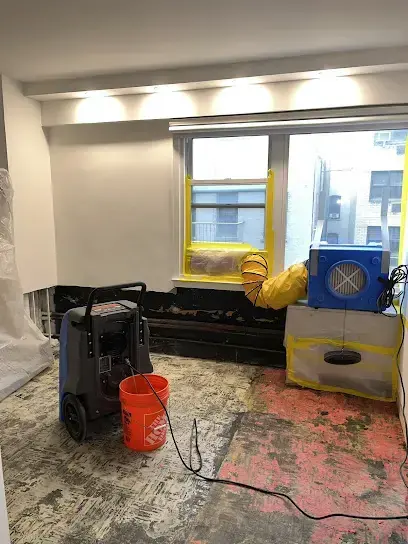
The extraction crew removes the standing water, then the drying team sets air movers and dehumidifiers to match the readings. Work on radiator and boiler leak water damage usually comes down to hardwood, subfloor and plaster, and each dries differently.
Boards that have started to cup are often dried with floor panels that draw moisture out from above, and plaster is dried through small openings rather than torn out whole. The method is described under structural drying.
Heating water is not clean drinking water. It often carries rust and sludge, so soaked insulation and other soft materials are checked and removed when needed.
Apartment blocks, two family homes and the unit below
Brookline's brick apartment blocks along Beacon Street, its two- and three-family homes and its condo conversions stack households on top of one another. A radiator leak in an upper unit can drip through the floor into the ceiling below, so the neighbor underneath is often the first to see it.
Telling the owner or manager at once, and photographing the stain below, gives everyone a clear record. The ceiling below is its own job, described under ceiling leak water damage.
A quick look before cold weather settles in
A short walk through the house before the heat runs steadily can catch a problem while it is still a drip.
- Look at every radiator valve and union for crust, rust trails or a damp ring.
- Check air vents for sticking or spitting.
- Read the boiler's pressure gauge when the system is cold and again when it is hot, and note both.
- Look at the floor under the boiler and under the relief valve pipe for drips or rust marks.
- Check ceilings below radiators for new stains.
Questions
Can a radiator keep running while it leaks?
A leaking radiator adds water to the floor every time the system cycles. Closing its valve and having a heating technician repair it is safer than running it.
How does a boiler leak go unnoticed?
An automatic fill valve tops up the system as water is lost, so the boiler keeps working. Rust stains, a drip at the relief valve pipe or a damp spot on the floor are the usual clues.
Is the water from a heating system clean?
Not reliably. It often carries rust and sludge, and what it touched matters, so soaked insulation and other soft materials may be removed even after a small leak.
Does hardwood under a radiator have to be replaced?
Not always. Boards that are only damp can often be dried, while boards that have cupped or turned black are checked with readings before anyone decides.
Who is called first, a heating technician or a restoration team?
Both are needed. The technician stops the leak at its source, the restoration team removes the water and dries what it reached, and the two jobs can run side by side.